Sentinel-AI
Financial Risk Research & Simulation
 Source Code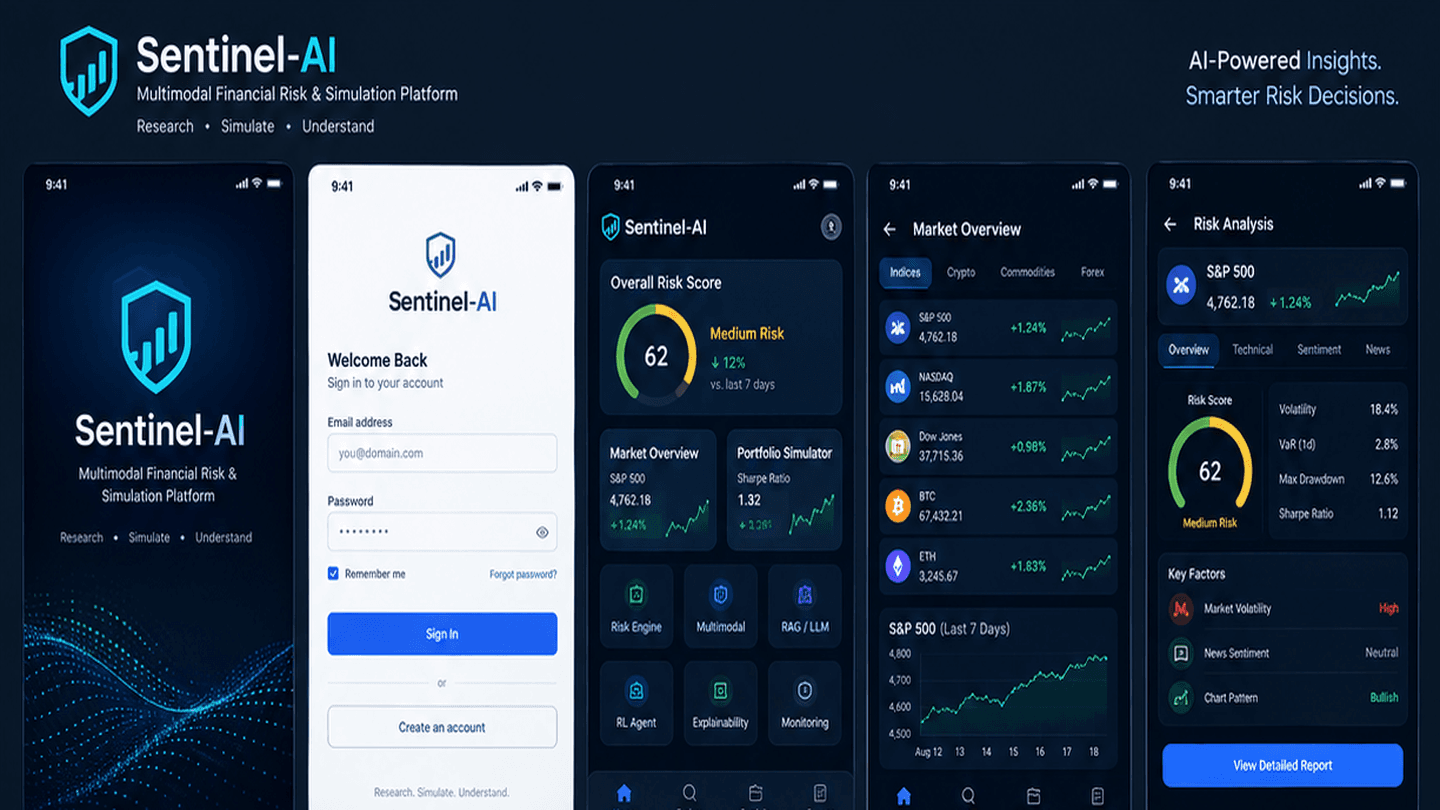
Overview
Sentinel-AI is a modular, enterprise-grade financial risk research and simulation platform built as a 5-phase academic research project (631-page thesis, ESTIN Bejaia). Phase 1 ingests OHLCV market data, engineers features (log returns, volatility, momentum, RSI), applies PCA dimensionality reduction, and trains a LightGBM regressor for risk/volatility scoring tracked via MLflow. Phase 2 fuses tabular signals with FinBERT news-sentiment embeddings (NLP engine) and CNN candlestick chart-pattern recognition (vision engine) into a unified multimodal risk representation via a late-fusion PyTorch head. Phase 3 retrieves relevant SEC filings and financial news from a pgvector-backed vector store via LangChain and generates grounded natural-language risk explanations using an LLM. Phase 4 introduces a simulated market environment (Gymnasium) with Q-Learning and PPO agents for simulation-only portfolio management. Phase 5 covers SHAP/LIME explainability, adversarial robustness, differential privacy, subgroup bias auditing, and drift detection (PSI). Phases 1–2 are fully implemented with trained models; phases 3–5 are designed with service scaffolding.
Problem & Solution
Financial risk analysis requires integrating heterogeneous data sources — market OHLCV data, news sentiment, chart patterns, and regulatory filings — into a unified, explainable risk scoring system.
Five-phase research platform: LightGBM risk scoring → FinBERT + CNN multimodal fusion → RAG-grounded LLM explanations → RL simulation → Trust & explainability auditing.
Architecture & Dataflow
Technical Stack & Implementation
AI / ML & Models
- LightGBM
- Scikit-learn (PCA, StandardScaler)
- FinBERT (ProsusAI/finbert)
- PyTorch CNN
- LangChain
- SHAP
- LIME
Backend & APIs
- FastAPI
- Python
- Uvicorn
- Pydantic
Data & Storage
- NumPy
- Pandas
- PyArrow
- pgvector
- PostgreSQL
DevOps & Infra
- Docker
- Kubernetes
- Redis
- Prometheus
- MLflow
Technical Challenges & Solutions
Fusing heterogeneous data modalities (tabular + text + image) into a coherent risk representation
Ensuring the LLM explains risk scores without making financial predictions
Balancing model complexity with inference latency for real-time risk scoring
Key Highlights & Results
Phases 1–2 fully implemented with trained models (MLflow runs, .pt and .safetensors artifacts)
631-page academic thesis documenting full system design and evaluation
Modular service architecture — each engine independently deployable via Docker